
Most men don’t take their prostate health seriously until something goes wrong. It often starts with small changes such as waking up at night more than usual or the constant urge that interrupts daily routine.
When the prostate grows big, it can cause discomfort, confusion, and a lot of unanswered questions that affect peace of mind. One of the most helpful ways to address such a situation is a friendly explanation, as it is a common and easily manageable condition.
This blog explores more about prostate enlargement, explains its causes, the effect it has on daily life, and the methods through which doctors can bring back the feeling of comfort.
Understanding Prostate Enlargement
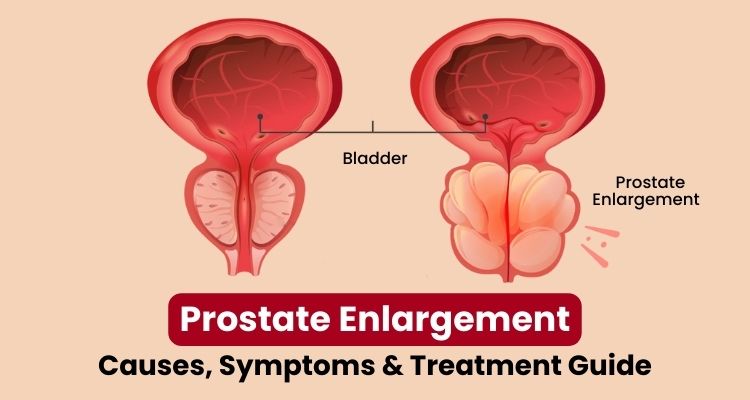
Prostate enlargement or benign prostatic hyperplasia is a non-cancerous increase in the size of the prostate gland that happens slowly over time. Generally, the prostate naturally grows in two main phases. The first growth happens during puberty when the gland becomes almost twice its size.
The second phase of prostate enlargement age group is around 25 and it continues throughout a man’s life. Sadly, most men don’t notice anything during the early stage. Symptoms appear much later when the prostate has enlarged enough to put pressure on the urinary system and cause major changes.
Causes of Prostate Enlargement
Although several explanations bring insight into why the gland grows, a clear cause has not been identified yet.
A major reason behind prostate enlargement causes is ageing because the enlargement tends to appear more frequently in older men. Natural changes in the male hormones of later years may be a factor in prostate growth. The prostate tissue can respond to these hormonal shifts by increasing in volume.
Other conditions can also cause enlargement.
- Prostrate cancer
- Acute prostatitis
- Chronic prostatitis
It is necessary to check these situations independently, as their symptoms might be very similar to those of benign prostatic hyperplasia. The assessment that is done with great care will definitely lead to the right treatment and will not cause mixing up the diseases.
Symptoms of the Prostate Enlargement
The prostate that has become enlarged may be the reason that the urethra and the bladder outlet are compressed, and thus, the urinary tract problems can be detected. A lot of men gradually become aware of the changes that take place. Some changes may be slight and stable, which, for the most part, can minimise interference with daily life. Others may worsen slowly or may even improve on their own with no treatment.
Common prostate enlargement symptoms include:
- Frequent or urgent need to urinate
- Waking up to pee several times at night
- Difficulty starting to urinate
- A weak or intermittent urine flow.
- Dribbling at the end of urination
- Feeling that the bladder has not emptied completely
Less common symptoms that may appear in some individuals include
- Urinary tract infection
- Complete inability to urinate
- Blood in the urine
A surprising fact is that symptom severity does not always correlate with prostate size. A slightly enlarged gland may bring significant difficulty, while a very large gland can produce only minimal problems. A few have no symptoms at all despite an enlarged prostate.
Diagnosing Prostate Enlargement
Initial Assessment
Diagnosis for BPH typically begins by discussing prostate symptoms, where a doctor listens to the kinds of urinary problems one experiences and how much they have affected daily life. Tests are conducted primarily to rule out complications, exclude other conditions, and further outline the condition of the gland and bladder.
A physical examination helps in the estimation of prostate size. The doctor inserts a gloved finger into the rectum to feel the back surface of the gland. This provides a great insight into the texture and enlargement of the prostate.
The bladder may be examined through the abdomen to check for retained urine. Urine tests and blood tests may be done to assess kidney function, identify infection, and detect blood in the urine.
Expert Review
A visit to a urologist may be advised when symptoms are troublesome or complications appear. A specialist may advise more specific tests, especially when surgery becomes a possible option.
Possible tests include:
- Cystoscopy to directly visualise the inside of the bladder.
- Urine flow test to measure the degree of obstruction
- Ultrasound scan to determine the post-void residual amount of urine
- A voiding diary is kept to document the frequency and amount of urine passed and the amount of fluid taken daily.
- A prostate-specific antigen blood test may also be offered because larger prostates may produce more PSA. This test can help understand prostate size, although it is not used routinely.
A high PSA level may appear in prostate cancer as well, which means results must be interpreted carefully. Many men with urinary symptoms do not have prostate cancer, and reassurance is an important part of the consultation.
Treatment Options for Prostate Enlargement
Watchful Waiting
Some men have mild symptoms that do not require immediate treatment. They might be advised to adopt a wait-and-observe policy. Frequent check-ups allow the physician to see any changes and to take action if the early signs of prostate enlargement get worse.
It is true that a great number of people perceive that their condition stays unchanged for a very long time, and a few of them even get better spontaneously.
Medications
Prostate enlargement treatment becomes necessary once urinary issues interfere with routine life. Medications help improve comfort, although they do not cure the condition.
Two main groups of medicines are used:
- Alpha Blocker Medications
These medications will loosen the prostate and the smooth muscle of the bladder neck, thus making urine flow better and the obstruction less severe.
- Five Alpha Reductase Inhibitor Drugs
These medications block one unit of the enzyme which converts testosterone into the more potent form, dihydrotestosterone, in the prostate. The decrease in the prostate gland’s cellular growth will occur, and there is a possibility that the prostate will be reduced in volume after some time.
Surgical Procedures for Prostate Enlargement
Some men need surgery when medicines do not help or symptoms are severe. Surgery removes or reduces the blocking prostate tissue. Only the central portion of the gland is removed, thus creating a wider channel for the urine to pass.
Common surgical techniques include:
- Transurethral Resection of The Prostate
A cystoscope is inserted through the urethra, and a heated wire loop removes small chips of prostate that are washed out later. This gives reliable relief. Retrograde ejaculation is common after this procedure, although impotence and incontinence appear less frequently.
- Transurethral Incision of The Prostate
Small cuts are made where the prostate meets the bladder. It widens the opening and improves flow. Retrograde ejaculation is less frequent than the previous procedure.
- Open Prostatectomy
This technique is reserved for very large prostates. The surgeon removes tissue through an incision. This method is rarely needed now.
- Laser Prostatectomy
Newer technologies involve the use of lasers to cut through or vaporise tissue. Green light lasers vaporise tissue, and holmium laser enucleation removes large pieces that are subsequently fragmented into smaller pieces.
Do you keep on thinking, Is prostate enlargement serious? Not so when you opt for the right treatment, like laser procedures. Laser procedures generally mean shorter lengths of stay in the hospital and fewer side effects. Thulium lasers are another option available at some centres.
Minimally Invasive Options for Prostate Enlargement
- Urolift
Small implants lift excess prostate tissue away from the urethra, opening the channel without removing tissue. It makes this approach a preferred option for people exploring prostate enlargement treatment without surgery in Mumbai. The risk of erectile dysfunction or ejaculation problems is minimal with this way of treatment.
- Rezum
This method uses water vapour injected into the prostate tissue to shrink the gland. Many patients undergo this as a short hospital procedure, which makes it a convenient option for most patients.
Final Thoughts
A clear understanding of prostate enlargement can bring confidence during this very confusing time. Most men regain comfort through timely evaluation and smart treatment choices. A specialist with strong expertise can guide these decisions and offer advanced minimally invasive solutions.
Dr. Kunal Arora is a top interventional radiologist in Mumbai with a treasure of knowledge and experience in treating complex vascular and urological diseases. Surely, a visit to Dr. Kunal Arora will aid you in finding a cure and achieving optimal prostate health.
Schedule a consultation with the doctor today and initiate your journey to ease and explanation!