
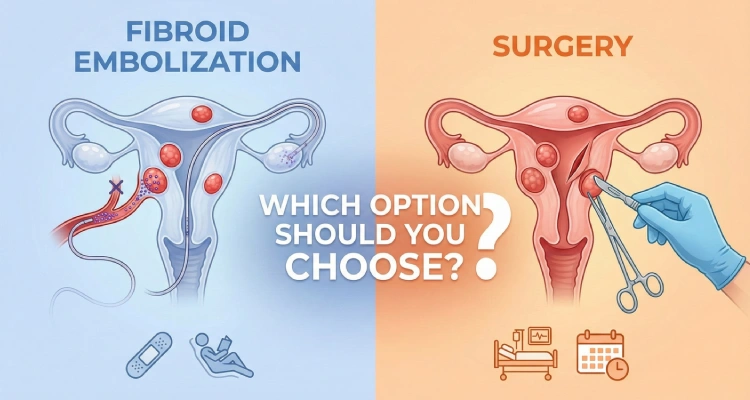
Tired of living with heavy periods and constant pelvic pressure? These symptoms generally indicate fibroids, and choosing the right treatment can feel overwhelming. A choice between fibroid surgery vs UFE determines factors of comfort, recovery time, and future plans. Taking care of fibroids has passed the era of major surgical operations, and all modern options focus on bringing relief without long stays in the hospital.
Uterine fibroid embolisation offers a minimally invasive way that strikes at the very source of fibroids, while surgery remains an option to consider in certain cases. The clearer the facts, the easier the choice. This comparison explains what matters most before such a decision is made.
Understanding Uterine Fibroids
Uterine fibroids are benign tumours that can grow in the uterus either internally or externally. Fibroids may be of different sizes and can also vary in number, ranging from small ones that are difficult to see to massive tumours that have the ability to alter the shape of the uterus.
Most of the time, women are symptom-free, and fibroids are found in their preventive examinations. The only women who have such diseases are those who can have heavy or long-lasting menstrual bleeding, a feeling of heaviness in the pelvis, pain in the lower back, or frequent urination, and these symptoms can make it difficult to work or carry out daily personal activities.
Nevertheless, medical science has not pinpointed a single definite cause. Research has indicated that the development of fibroids is mainly controlled by heredity and hormonal factors. These hormones, estrogen and progesterone, help fibroids grow, which is why they are more common during the reproductive years. The risk factor is still kept in the late thirties and during the forties.
Usually, diagnosis is a pelvic exam, which can be later enhanced by imaging studies like ultrasound and MRI. These tests locate, size, and count the fibroids, and, according to the patient’s needs, the doctor can decide the best treatment plan.
What is Uterine Fibroid Embolisation?
Uterine Fibroid Embolisation, more commonly referred to as UFE, is a non-surgical medical therapy done by the interventional radiologist. The main aim of this treatment is to shrink the fibroids, but not take them out. Patients will receive moderate sedation for comfort. A small incision in the area near the wrist or upper thigh enables a thin catheter to travel through blood vessels to the uterine arteries.
The uterine fibroid treatment without surgery in Mumbai consists of the delivery of certain microscopic agents to block the blood supply to the fibroids. Fibroids need this blood supply to grow and to cause symptoms. So after being cut off from the supply of nutrients, they become smaller step by step, and hence bleeding and pelvic pain get alleviated with the passage of time.
The procedure normally takes an hour to ninety minutes. After a short observation period, most patients return home the same day with support. Usually, people are able to get back to their daily routines in less than a week, which makes UFE very attractive to those women who want to feel better but don’t want to go through a big operation. With this method, women can keep their uterus, thus having the possibility of becoming mothers later on.
Surgical Options to Treat Fibroids
Comparing UFE vs fibroid surgery, surgical treatment of fibroids is one of the traditional ways of managing the disease. The two common surgical methods are myomectomy and hysterectomy. Each option approaches fibroids in a different manner and applies to different medical conditions.
Myomectomy
Myomectomy involves the surgical removal of fibroids, preserving the uterus. This is a preferable option for many women, as symptoms are relieved while fertility is preserved. Surgery can be performed using an open, laparoscopic, or robotic technique, depending on fibroid size and location.
A risk of recurrence also exists. The presence of multiple fibroids increases the chances of developing new fibroids following surgery. In fact, research studies have found that recurrence rates are significantly lower when a single fibroid has been treated as opposed to cases involving multiple growths. Recovery time can take several weeks and necessitates abstaining from regular activities.
Hysterectomy
A hysterectomy removes the uterus altogether and can resolve fibroids permanently. The doctor will recommend this option when symptoms are severe and unresponsive to other treatments. Permanent decline in fertility, alterations of hormonal effect that induce early menopause symptoms, are the side effects generally reported.
The physical and emotional effects vary, and the recovery times are usually from 2 to 6 weeks, but may also be longer in some cases. Besides that, surgical risks and exposure to anaesthesia should also be taken into account.
UFE vs. Surgery: How They Differ?
Treatment selection between UFE vs surgery for fibroids is based on medical goals, severity of symptoms, and personal preference. UFE and surgery have significant differences in approach and recovery.
- Invasiveness
UFE operates with a minor incision and image guidance, hence leaving out the large surgical cuts that were normally required. Surgery requires more extensive physical intervention.
- Recovery Time
For the recovery time between fibroid embolization vs surgery comparison, most patients with UFE return to normal activities within days. Surgical recovery may extend up to several weeks.
- Hospital Stay
UFE is usually a same-day discharge, while surgical procedures may involve longer hospitalisation.
- Fertility Considerations
Uterine fibroid embolization in Mumbai preserves the uterus, though pregnancy outcomes vary. Myomectomy may be beneficial for women with specific fertility goals.
- Symptom Relief
Both methods are effective in relieving symptoms. UFE relieves symptoms without the removal of reproductive organs and does not require open surgery.
Recovery Time and Expected Outcomes
Recovery also plays a significant role in the choice of treatment between uterine fibroid embolization vs surgery. Generally, recovery after UFE takes about a week. Thus, the woman can go back to work and other activities as soon as possible. Recovery may be mild and characterised by mild cramping or fatigue.
Surgical recovery may include times of limited activity, pain management, and prolonged rest. Depending on procedure type, time away from work and family responsibilities may stretch into months.
Both treatments have the objective of minimising bleeding, pressure, and pain. Many women report substantial improvement in symptoms after UFE, which is associated with only a small disruption in daily life.
Fertility and Reproductive Health
Fertility planning is one factor that influences fibroid treatment options. UFE keeps the uterus intact, and thus, it is a better choice visually for those ladies who want to keep the ability to reproduce. Although some women may conceive after UFE, the outcome is best conditioned by the general health status.
If the fibroids interfere with the uterine cavity, myomectomy is usually the preferred option for a woman who is willing to have a baby. In case of doubt, as should I choose UFE or fibroid surgery, a doctor is the best person to give you advice as to which option will be safest for you in terms of fertility.
Conclusion
Clarity, medical guidance, and confidence are important for choosing between fibroid treatment: surgery or UFE. Both options offer symptom relief that is meaningful. However, personal health goals may dictate the best path forward. Expert care can make all the difference in outcome and recovery experience.
Dr. Kunal Arora is ranked as the top interventional radiologist in Mumbai. He has over 9 years of rich experience and highly advanced skills in vascular and interventional radiology. His focus is on fibroid treatments that save the uterus, such as UFE.
Book an appointment with Dr. Kunal Arora to talk about a personalised plan for your fibroid treatment and make a move towards permanent relief.