
Frequent trips to the bathroom and disturbed sleep can slowly become part of daily life for people with an enlarged prostate. When these symptoms get worse and simple treatments no longer help, doctors may suggest more advanced procedures.
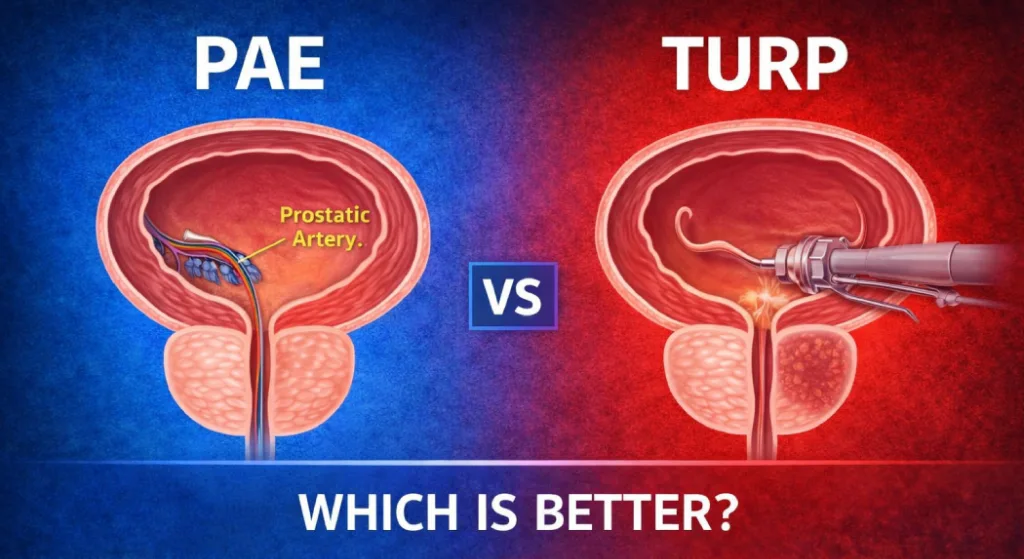
Two procedures are commonly recommended, such as PAE and TURP. However, choosing between PAE vs TURP may not be an easy task. One may provide a less invasive solution, but the other has been considered a standard solution for a long time. Each method promises a different experience, recovery, and results.
But which option fits your lifestyle and needs best? Let’s analyse the situation and see what matters most.
Understanding Both Procedures
Prostate Artery Embolisation (PAE)
It is a minimally invasive technique in which the size of the prostate gland is reduced by cutting off the blood supply to the enlarged prostate. This technique is performed by an interventional radiologist in Mumbai with the aid of images. A small cut is made in the skin of the patient, and a small catheter injects materials into the blood vessels of the prostate gland.
- Targets the prostate’s blood vessels
- Causes gradual shrinkage over weeks to months
- Preserves the structure of the prostate
- It does not need surgical cuts or removal of tissues
Transurethral Resection of the Prostate (TURP)
This is a kind of surgery that entails the removal of tissues that hinder the flow of urine. In this case, a medical expert makes use of instruments that are inserted into the urethra for the removal of the prostate tissues. This method provides immediate relief.
- Removes blocking prostate tissue directly
- Improves urine flow almost immediately
- Requires surgical expertise
- Involves cutting and removing tissue
Detailed Procedure Comparison
Invasiveness and Approach
PAE
- Single needle puncture, most commonly in the groin or wrist
- Does not involve any incisions or organ removal
- Conscious sedation
- An outpatient procedure that lasts between 60 and 90 minutes
TURP
- Medical instruments are inserted through the penis
- Requires general or spinal anaesthesia
- Conducted in an operating room
- Takes around 1-3 hours and may need a hospital stay
Recovery Timeline
PAE Recovery
- Same-day discharge
- Return to work in 3-7 days
- Full activity within 1-2 weeks
- Symptom improvement over 3-6 months
TURP Recovery
- Hospital stay of 1-3 days
- Catheter required for 1-3 days
- Return to work in 2-4 weeks
- Full recovery in 4-6 weeks
- Immediate symptom relief after the procedure
Faster recovery and a shorter hospital stay often make PAE a more convenient option for many patients when you compare prostate artery embolization vs TURP.
Effectiveness and Outcomes
Symptom Relief Comparison
Research shows both procedures improve urinary symptoms and quality of life over time.
PAE Outcomes
- Noticeable improvement in urinary symptoms
- Around 20-30% reduction in prostate size
- Gradual and steady relief
- High patient satisfaction
TURP Outcomes
- Immediate improvement in urine flow
- Larger reduction in prostate size
- Faster symptom relief
- Strong clinical history of effectiveness
- Long-Term Success Rates
PAE
- 80-90% of patients experience lasting relief
- Less need for additional treatment
- Results improve gradually over time
TURP
- Long-standing standard treatment
- Excellent long-term results
- Low retreatment rates
- Immediate and sustained benefits
Risk and Complication Profiles
PAE Safety Profile
PAE generally carries a lower risk of complications compared to surgical options.
Minor complications:
- Flu-like symptoms for a few days
- Urinary discomfort
- Mild pain in the pelvis
Serious Complications (rare):
- Need for antibiotic treatment
- Urinary retention
- Bleeding at the puncture site
- The overall complications are fewer compared to the TURP.
TURP Risk Profile
TURP involves higher risks due to its surgical nature.
Common Complications:
- Retrograde ejaculation in most patients
- Temporary urinary incontinence
- Urinary infections
- Blood in urine during recovery
Serious Complications:
- Bleeding requiring transfusion
- Urethral narrowing
- Permanent incontinence (rare)
- Electrolyte imbalance in rare cases
Sexual Function Considerations
PAE and Sexual Health
- PAE generally preserves sexual function.
- Minimal impact on erectile function
- Ejaculation usually remains normal
- No direct interference with the sexual organs
- Gradual recovery allows adjustment
- Some temporary changes may occur, but long-term function is usually maintained.
TURP and Sexual Health
- TURP can affect certain aspects of sexual health.
- Retrograde ejaculation occurs in most cases
- Fertility may be affected
- Erectile function is usually preserved
- Orgasm sensation typically remains
- Dry orgasms become common after the procedure, although overall satisfaction often stays stable.
Making Your Treatment Decision
Choose PAE if:
- You prefer a minimally invasive option
- Faster recovery is important
- Preserving sexual function is a priority
- You want to avoid surgery and anaesthesia
- You are comfortable with gradual improvement
Choose TURP if:
- You need immediate symptom relief
- The prostate size is significantly large
- You are prepared for surgical recovery
- You accept possible sexual side effects
- You want a long-proven treatment option
Important Factors to Consider
- Prostate size and condition
- Severity of symptoms
- Overall health status
- Past treatments
- Personal comfort with risks
Lifestyle factors such as work schedule, recovery time, and personal priorities also play an important role when deciding on TURP vs PAE which is better for your situation.
Expert Consultation Process
A detailed consultation helps determine the best treatment for your condition.
- Evaluation of prostate size and structure
- Assessment of symptom severity
- Understanding suitable treatment options
- Discussion of expected outcomes
- Review of potential risks and alternatives
Personalised guidance ensures the treatment aligns with your health needs and lifestyle.
Conclusion
The choice to make between PAE vs TURP for enlarged prostate is based on your symptoms, lifestyle, and the speed at which you want the results to be achieved. While PAE gives you a non-invasive solution with quicker recovery, TURP gives you immediate results with a more invasive solution. Seeking advice from the right professional can help you make the right choice.
Dr. Kunal Arora, one of the best interventional radiologists, can guide you to the best solution for your prostate enlargement treatment without surgery in Mumbai with a patient-focused approach. Dr. Kunal Arora’s expertise in Interventional Radiology can help you achieve the best results for your medical condition.
Want to achieve the best non-surgical solution for your medical condition? Consult with us today and start your way to a better lifestyle!